STUDY

| Institution code: | S82 |
|---|---|
| UCAS code: | B750 |
| Start date: | September 2027 |
| Duration: | Three years full-time |
| Location: | Ipswich |
| Typical Offer: | 120 UCAS tariff points (or above), BBB (A-Level), DDM (BTEC), Merit (T Level) |
| Institution code: | S82 |
|---|---|
| UCAS code: | B750 |
| Start date: | September 2027 |
| Duration: | Three years full-time |
|---|---|
| Location: | Ipswich |
| Typical Offer: | 120 UCAS tariff points (or above), BBB (A-Level), DDM (BTEC), Merit (T Level) |
Overview
Dental hygienists and dental therapists play a vital role in preventing and treating oral disease. You’ll learn how to support patients through oral health education, dietary advice, periodontal care, scaling and polishing, preventive treatments and dental radiography. As a dental therapist, you’ll also develop the skills to carry out a range of restorative procedures, including fillings, extracting primary (baby) teeth, placing preformed crowns and providing pulp therapies for primary teeth. This broad scope of practice will prepare you to deliver comprehensive, patient-centred care as part of the modern dental team.
Learn through clinical experience
Combining academic study with extensive clinical experience, the programme will help you develop the practical skills, professional confidence and clinical judgement needed for contemporary dental practice. You’ll gain experience in a variety of clinical environments, working alongside experienced dental professionals to deliver safe, effective and compassionate care.
Your future career
Graduates will be equipped to pursue rewarding careers across the NHS, community dental services, private and specialist dental practices, and other healthcare settings. Subject to successful completion of the programme and the relevant GDC requirements, graduates will be eligible to apply for registration as both a Dental Hygienist and a Dental Therapist, opening up opportunities to practise across the full scope of both professions.
The programme underwent a General Dental Council (GDC) quality assurance inspection in October 2026, demonstrating its commitment to meeting the GDC’s Standards for Education. A significant milestone has already been achieved, with the first two students successfully joining the GDC register as Dental Hygienists through the approved interim exit award pathway. The programme continues to progress towards full accreditation for the integrated Dental Hygiene and Therapy qualification.
Course Modules
Year one establishes the foundations on which clinical practice lie, namely biomedical sciences and developing clinical skills in a simulated setting. This is paralleled by development of personal and professional skills, such as communication strategies and their role in social responsibility.
Year two then builds on this skill-set, with clinical placements and introduces them to the dental specialities.
Year three consolidates learning and competence in technical and leadership skills, whilst developing research skills. Innovation and entrepreneurship is encouraged through self-selected, independent project-based learning in education, business development or research methods.
Downloadable information regarding all 小黄片app courses, including Key Facts, Course Aims, Course Structure and Assessment, is available in the Definitive Course Record.

This module supports students to develop effective academic skills, build resilience and wellbeing skills to assist them through their programme of study and beyond. As a dental professional, students are required to have an understanding of the law and moral reasoning is an important skill for health care staff.
This module is designed to provide students with foundation knowledge regarding the anatomy and
physiology of the head and neck region, considering embryonic development, and the recognition
of normal and variations from normal
This module focusses on periodontal disease and the diagnosis and management to treat patients.
This module continues to develop knowledge, clinical and technical skills to manage caries and non-carious tooth surface loss.
Students will learn about the disease processes that affect a medical history and how this could impact on the provision of oral health.
This module builds upon previous clinical skills development modules and continues to enhance existing technical clinical skills in the dental simulation laboratory.
Poor oral health is almost entirely preventable and despite good progress over the last few decades, is still prevalent in many communities. This module looks at prevention of oral diseases at the population and community level, and at the individual level are presented and discussed. Strategies will be identified and considered regarding their effectiveness.
This module will enable students to identify appropriate literature, understand the research process and methods as a basis for the formulation of a research proposal and continue this in the final year Dissertation module.
This module builds upon previous knowledge gained in Dentistry in Society 1, where some of the
concepts around health education and promotion were introduced. Dental public health at a whole
population level will be explored in order to consider current local oral health trends and needs across the East of England.
The final year dissertation will build upon the knowledge and skills gained from the Year 2 Research Skills for Oral Health module. It provides the opportunity for students to engage in a rigorous piece of independent study and to present findings through a dissertation.
This module will focus on supporting the student to transition from a clinician under supervision to that of a registered autonomous practitioner, working effectively in a team.
This module will continue to develop clinical practice skills development in primary and secondary
care placements.

WHY SUFFOLK
1st University of the Year
2nd Teaching Satisfaction
2nd Student Experience
Entry Requirements

Career Opportunities
The BSc (Hons) Dental Hygiene and Therapy course is currently undergoing accreditation by the General Dental Council (GDC).
The course will provide students with the theoretical and practical skills required to register as both a dental hygienist and dental therapist with the GDC.
On completion of the programme you will:
- Become eligible to register with the General Dental Council (GDC) when you graduate, which you'll need to work as a dental hygienist and/or therapist in the UK
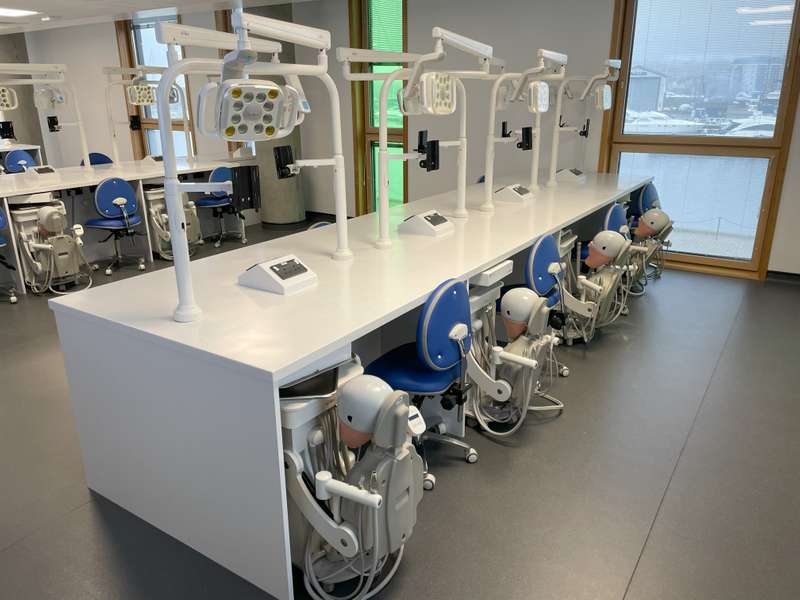
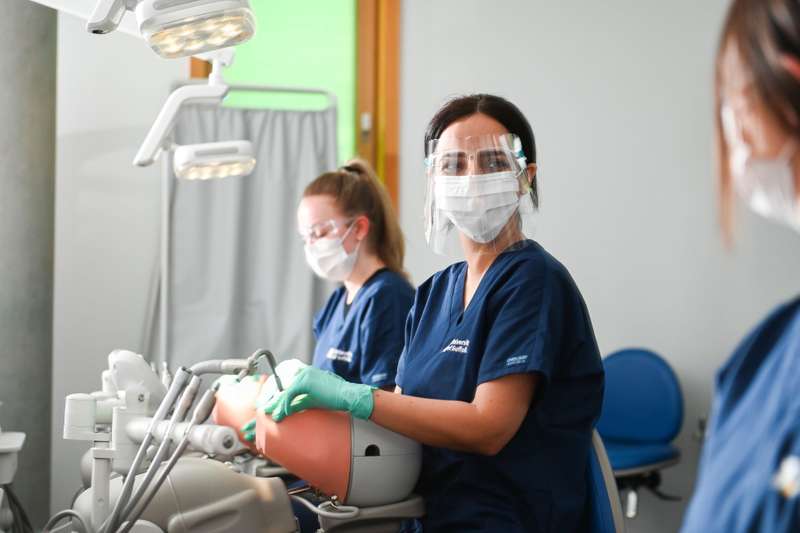
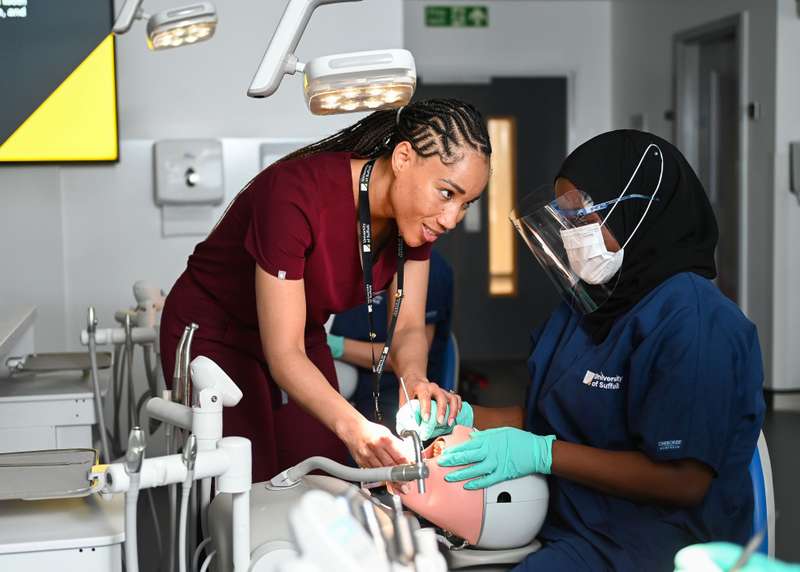
- Practise your skills in our Centre of Dental Development, with dental treatment bays and simulation technology, including our Phantom Head skills lab and radiography equipment
- Work in a dental team alongside practising dentists, dental nurses and other students, giving you a taste of your future work environment
- Have the chance to work with the public through community healthcare projects, providing additional patient-focused work experience.
Our Careers, Employability and Enterprise Team are here to support you, not only whilst you complete your studies, but after you graduate and beyond.
To find out more about our range of services and support, please visit our Careers, Employability and Enterprise page.
Your Course Team


Facilities and Resources
Our state-of-the-art teaching facilities, including a fully computerised phantom head laboratory, exclusive training clinics, dedicated study spaces and computer clusters, provides you with access to world-class research facilities and a modern learning environment.
Clinical practice is a major component early on in the course. This experience will help to prepare you for seeing your first patient during the second term of your first year. During your course you will be working in dental practices across Suffolk and in the 小黄片app’s brand new, state of the art, on-campus dental practice.


Related Courses

The BSc (Hons) Nutrition and Human Health degree program will take you on an exciting journey to become a competent nutritionist.

This course is aimed at those who have little experience of knowledge of the field, or who have been out of education for a while and are looking to rebuild their knowledge and confidence in the science disciplines.
Related News



NEXT STEPS
Now you know more about the course, we can guide you through the next steps.